
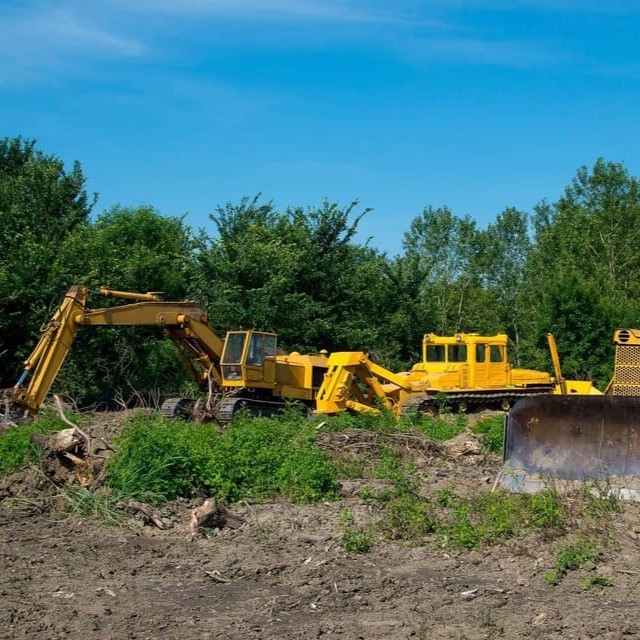
Tree protection during construction starts before the first machine reaches the lot. On a job site, the damage that kills a tree usually happens underground, where heavy equipment and foot traffic compact the soil over its roots. Root pruning before excavation and a fenced-off root zone give a tree its best chance of making it through the project.
Why Construction Kills the Trees You Meant to Keep
When we’re brought in before a project, the biggest mistake we see is soil compaction from equipment running over the root zone.
Tree roots need loose soil with space for air and water. A skid steer crossing the root zone presses that soil tighter with every pass, and daily foot traffic does the same thing more slowly. Atlanta’s clay compacts easily, and UGA Extension’s Bartow County office notes that roots grow closer to the surface in clay than in sandy soil. Once that soil is packed down, the roots can’t take in what the tree needs.
The tree won’t show it right away. Decline from soil compaction can take three to seven years to appear, which makes construction damage to trees hard to trace back to the job. Atlanta’s Tree Protection Ordinance counts root zone damage from heavy machinery or stored materials as one way a tree can be destroyed, a status that can trigger recompense.
What Is the Critical Root Zone?
The critical root zone is the area around a tree that holds most of the roots it depends on. The City of Atlanta defines it as a circle with a radius of 1 foot per inch of trunk diameter, measured 4.5 feet above the ground. A 20-inch oak’s critical root zone reaches 20 feet from the trunk in every direction, often well past the canopy edge.
The tree protection zone is the fenced area on the site plan. Atlanta requires the fence at the edge of each critical root zone or at the work limits, whichever protects more, using 4-foot plastic fence at minimum. Other cities size these zones differently.
Root Pruning Before the First Shovel
Root pruning means cutting roots cleanly at the edge of a planned dig, and it should happen before the project kicks off. Without it, an excavator severs roots wherever the trench happens to fall, and severed roots die from the cut outward.
When root pruning trees ahead of a project, our arborists expose the roots crossing the staked excavation line with hand or air tools, then cut each one with a saw.
Placement matters too. UGA’s guidance warns that severing too many large anchor roots can leave a tree prone to uprooting.
How to Protect Trees During Construction
Knowing how to protect trees during construction comes down to deciding where machines and materials can’t go, then holding that line. Tree protection fencing goes up before equipment arrives and stays up through final grade. Parking, material stockpiles, and the dumpster all belong outside it.
When a crew has to drive or walk across a root zone, Atlanta’s ordinance lists protective layers such as mulch, plywood, access mats, or temporary decking. The layer spreads the weight so the soil underneath compacts less.
Utility lines need their own plan. New utility lines usually go in through an open trench, which cuts every root it crosses. Boring a tunnel under the root zone leaves those roots in place.
Watch grade changes too. In clay soil, the same UGA guidance puts significant root damage at cuts deeper than 2 inches, and 3 inches of added fill can kill roots outright.
Which Trees Are Worth Saving?
The trees worth saving are healthy and structurally sound, with most of their root zone outside the work limits. An arborist weighs a tree’s health and structure against how much of its root zone the plan will take. A tree with a cavity at the base or a canker on a main limb has less margin to absorb root loss. Our guide to tree cankers and cavities covers those conditions.
Species matters as well. We try to get every client with a Bradford pear to remove it, so one standing in the path of a new driveway isn’t worth an elaborate protection plan. We’re strong proponents of native trees, and a healthy native oak is the kind of tree a protection plan is built for. When trees do need to come out, our tree removal process plans each cut around the trees that remain.
Atlanta’s tree planting plan calls for a new tree for each destroyed tree, where the site has room. Our tree planting service can plant those replacements and coordinate the paperwork.
How Close Can You Build to a Tree?
In Atlanta, a tree counts as saved only when construction disturbs 20% or less of its critical root zone and leaves its structural root plate alone. That plate is the dense mass of roots near the trunk that anchors the tree against wind. How close that lets you build depends on the tree’s size.
For that 20-inch oak, the critical root zone covers about 1,256 square feet, so 20% comes to roughly 250 square feet. A pool excavation can use that up fast. The root plate on a tree that size reaches about 9 feet from the trunk. Roots rarely grow in a perfect circle near foundations and streets, so a site visit gives a more reliable answer than a formula.
Bring in an Arborist Before Permitting
Book an arborist consultation before the plans are final, while a footprint can still shift or a utility line can still move. That’s the window for getting a tree survey and root zone impact numbers onto the plan the city reviews. After the damage, the options shrink to documenting the loss and helping the tree recover.
In the City of Atlanta, tree protection during construction is written into the permit process. Sites with trees within 50 feet of proposed work need a tree protection plan with a tree survey. The city then sorts each tree by how much of its root zone the work will touch:
- 20% or less of the critical root zone impacted, root plate untouched: the tree counts as saved.
- 20% to 33% impacted: the tree can still be saved through an approved arboricultural prescription. An ISA-certified arborist monitors the protection measures and reports to the City Arborist before the certificate of occupancy.
- More than 33% impacted, or root plate disturbed: the city considers the tree destroyed.
Rules differ by city. Our guide to tree removal rules across metro Atlanta compares how they vary.
For Homeowners Planning an Addition or Pool
- Call an arborist when you start talking with your designer or pool contractor, before drawings go to the city.
- Ask for a tree protection zone around each tree you want to keep, marked on the plans.
- Ask where equipment will enter the backyard, since that route crosses any root zone in its path.
If a neighbor’s tree has roots crossing your lot, Atlanta’s plan has to protect its root plate and at least 805 of its critical root zone.
For Contractors and Developers
Any tree the city counts as destroyed carries recompense, so tree protection belongs in the schedule from the start. Atlanta’s ordinance also expects tree-friendly methods where they fit, such as pier-and-beam foundations to reduce grading.
Our arborists write tree protection plans for contractors and developers, which puts root zone impact percentages in front of you before plan review, while the layout can still change.
Plan for the Trees Before the Groundwork Starts
Tree protection during construction works best when it’s on the drawings before the city’s arborist reviews them. Planning an addition or pool on a lot with trees you want to keep? Schedule a consultation with Green America Tree Care’s ISA-certified arborists before the plans go in for permitting. We can write the tree protection plan and root prune ahead of excavation.